
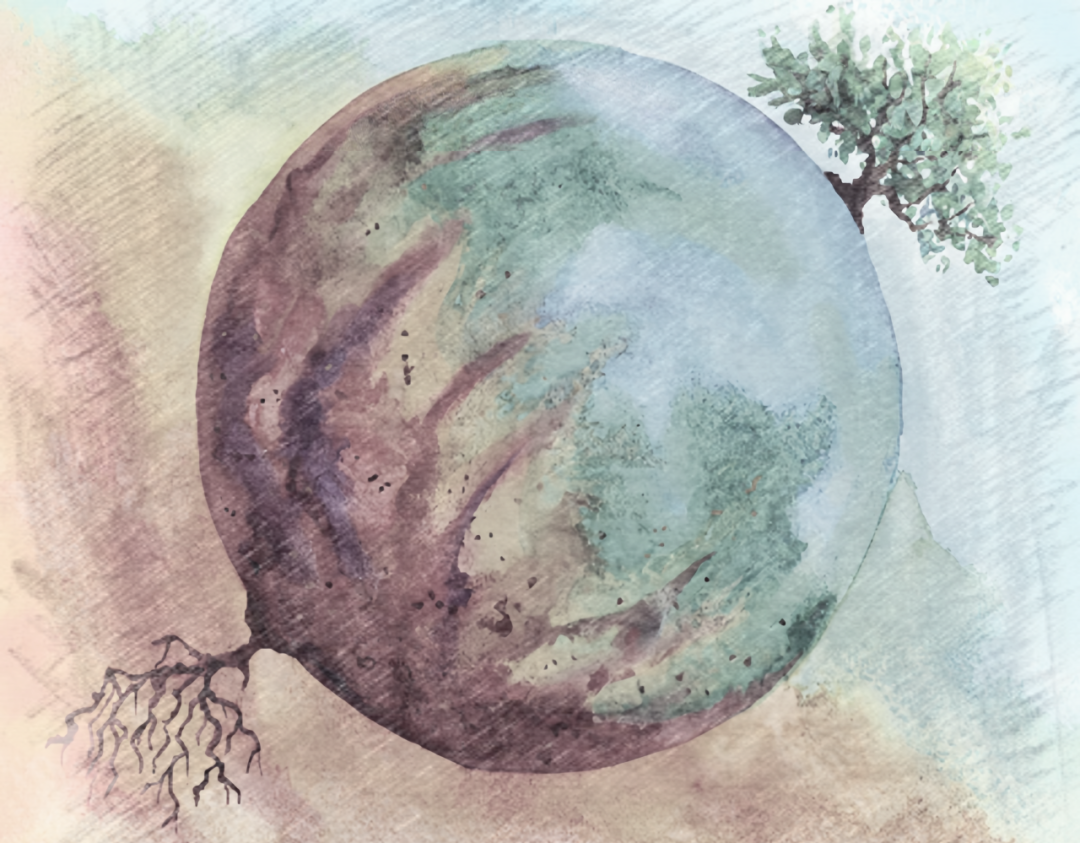

是时候衡量你的艺术洞察力了:能否运用“审美分析”方法,解读生态艺术作品中的观念传递?能否基于“视觉与听觉符号系统”,评判人类行为对环境的文化表征?
SDcamps•演辩营的2026CNAP《艺术学科模拟真题》正式发布,通过层次化命题,带你逐步解构艺术与环境的互动关系,建立从形式感知到社会意涵的完整诠释路径。
2026寒假辩论/演讲课程|哈佛、斯坦福邀请赛、WSC备赛课程
美国学术十项全能USAD(United States Academic Decathlon)是美国权威的综合性主题学术团队竞赛,迄今已拥有 50 多年的运营历史及学术积淀,拥有独特的团队竞赛方式,主题性跨学科的竞赛内容和极高的学术价值,主要针对高中生,被誉为“通往世界名校的主题通识学术挑战”。
初中版美国学术五项全能USAP(United States Academic Pentathlon)是针对初中学生权威的综合性主题学术团队赛,涵盖语言和文学(含写作)、艺术(美术&音乐)、科学、社会科学和数学被誉为“初中生最好的综合性学术竞赛”。
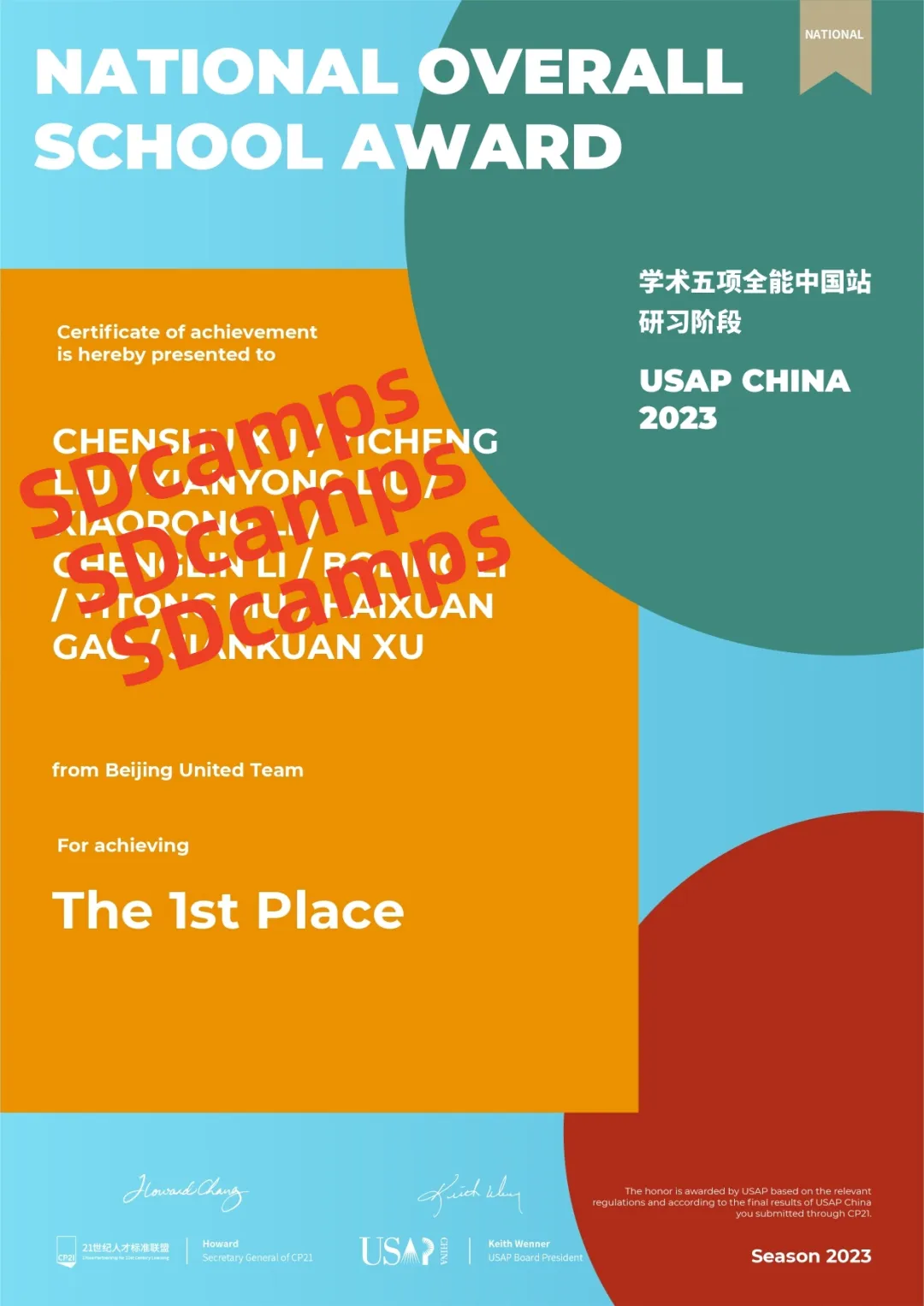
CNAP/CNAD是美国USAP/USAD的中国赛,使用相同的主题和赛制;SD提供全赛程辅导,学生们曾问鼎过该项赛事中国站冠军、全球站冠军的巅峰荣耀:
战队招募|征高手组队CNAP/CNAD,挑战美国学术五项/十项全能
巅峰荣耀 护航冠军
加盟我们的战队,与学术高手同行!选择SDcamps,也意味着您为孩子选择了一位深谙CNAP/CNAD赛制与得分策略的冠军引路人:
我们的学生与其他队友共组的北京联队,问鼎过该项赛事中国站冠军、全球站冠军的巅峰荣耀:

独家模拟真题首发
SD英语演讲与辩论的教研团队重磅推出《CNAP/CNAD 2026模拟真题》。该题库在精准把握初级站考核范围的基础上精心打造,全面对标官方题型、难度与命题逻辑。
题库设计严格遵循赛事真题“低阶—中阶—高阶”的三层递进逻辑:
低阶题目检验学生对核心概念与事实的记忆;
中阶题目考查对知识原理与逻辑关系的理解;
高阶题目则挑战学生跨章节整合信息、进行分析与推理的综合能力。
通过系统的针对性训练,能有效帮助学生提前适应考场节奏,精准定位自身在各难度层级的薄弱环节,从而实现科学备考、精准把握。
低阶
直接考察相关概念、核心事件、人物、关键发展
1. According to the guide, what is the broadest definition of music?
A) Sound organized in time
B) A composition written by a composer
C) Beautiful sounds made by instruments
D) Melody and harmony combined
2. What are the two main properties of a sound wave?
A) Pitch and Duration
B) Speed and Direction
C) Amplitude and Frequency
D) Loudness and Softness
3. In the Sachs-Hornbostel system, a violin is classified as a:
A) Aerophone
B) Idiophone
C) Membranophone
D) Chordophone
4. The distance between one musical pitch and the next pitch with the same letter name (e.g., A to the next higher A) is called a(n):
A) Scale
B) Interval
C) Step
D) Octave
5. What is the term for the steady pulse that underlies most music?
A) Rhythm
B) Meter
C) Beat
D) Tempo
6. In Western music notation, a symbol that indicates silence is called a:
A) Clef
B) Bar line
C) Note
D) Rest
7. What is the smallest identifiable recurring musical idea called?
A) Coda
B) Phrase
C) Motive
D) Theme
8. A-B-A-C-A is an example of what kind of musical form?
A) Ternary
B) Sonata
C) Binary
D) Rondo
9. The academic discipline dedicated to understanding art in its historical context is:
A) Aesthetics
B) Anthropology
C) Art Criticism
D) Art History
10. Which of the following is considered the most basic element of art?
A) Texture
B) Line
C) Color
D) Shape
11. In a two-dimensional artwork, the area occupied by the primary objects is called:
A) The Background
B) Negative Space
C) The Foreground
D) Positive Space
12. The technique of creating the illusion of depth on a flat surface is called:
A) Modeling
B) Composition
C) Texture
D) Perspective
13. Red, blue, and yellow are known as:
A) Secondary Colors
B) Tertiary Colors
C) Neutral Colors
D) Primary Colors
14. An artist's organization of elements like line, shape, and color in a work is called:
A) Form
B) Texture
C) Perspective
D) Composition
15. Which art process involves creating multiple original works using a plate or matrix?
A) Drawing
B) Painting
C) Printmaking
D) Sculpture
16. In sculpture, a work that projects only slightly from a background surface is in:
A) Bas (Low) Relief
B) Installation
C) Freestanding / "In the round"
D) High Relief
17. Ferde Grofé's Grand Canyon Suite is an example of what kind of music?
A) Programmatic Music
B) Sacred Music
C) Chamber Music
D) Absolute Music
18. In Grofé's "On the Trail," the clip-clop sound is created by a percussionist using:
A) Temple Blocks or Coconut Shells
B) Timpani
C) Xylophone
D) Snare Drum
19. Beethoven's Symphony No. 6 is nicknamed:
A) Eroica
B) Pastoral
C) Choral
D) Fate
20. In Beethoven's "Pastoral" Symphony, the storm scene is depicted in which movement?
A) First
B) Third
C) Second
D) Fourth
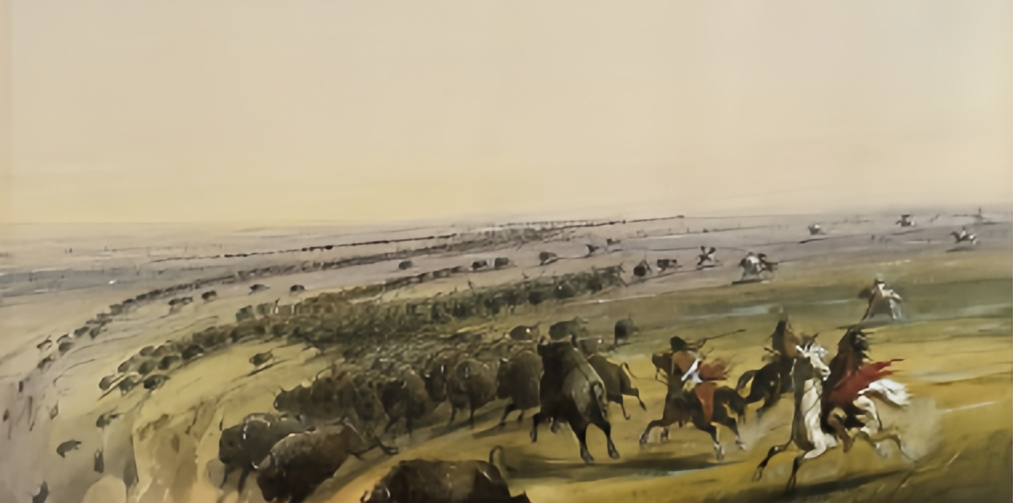
19th-century painting by Alfred Jacob Miller depicting Native American hunters driving bison off a cliff.
中阶
考察对于核心知识原理、原因、影响等理解
1. Why does the guide state that "a person (often called a composer)" is common but not required for music to exist?
A) Because music can be created by animals.
B) Because the definition focuses on sound organized in time and human perception, which can occur without a pre-planned composition.
C) Because all sounds are considered music.
D) Because music notation is more important than the composer.
2. How does halving the length of a vibrating string affect the pitch it produces?
A) The pitch becomes lower.
B) The pitch stays the same but gets louder.
C) The timbre changes.
D) The pitch becomes higher.
3. The guide explains that in a minor scale, the third scale degree is lowered compared to a major scale. This creates an interval from the tonic that is a:
A) Major Second
B) Perfect Fourth
C) Major Third
D) Minor Third
4. How does a fermata affect the music?
A) It pauses or extends a note/chord beyond its normal duration.
B) It tells the performer to get softer.
C) It indicates a note should be played very short.
D) It speeds up the tempo.
5. In musical form, an Introduction and Coda are often considered an outer "frame" because:
A) They must be repeated.
B) They are the longest sections.
C) They are usually disregarded when analyzing the core structure of the piece.
D) They contain the main thematic material.
6. According to the guide, how has the definition of "art" studied by art historians changed over time?
A) It has broadened to include many forms of visual and material culture beyond traditional "fine art."
B) It no longer includes architecture.
C) It focuses only on works with clear aesthetic appeal.
D) It has narrowed to only include painting and sculpture.
7. Why might an artist use atmospheric perspective?
A) To create precise mathematical lines converging at a vanishing point.
B) To make objects in the foreground less detailed.
C) To emphasize the texture of objects.
D) To make distant objects appear lighter, less distinct, and more neutral in color to suggest depth.
8. Creating balance by organizing unlike objects on either side of a central axis is known as:
A) Symmetrical Balance
B) Radial Balance
C) Approximate Symmetry
D) Asymmetrical Balance
9. In printmaking, what is the purpose of the "matrix" or plate?
A) It is the tool used to apply pressure.
B) It is the paper used for printing.
C) It is the final printed artwork.
D) It is the surface on which the image is created to transfer ink to paper.
10. Grofé's use of a cadenza for the violin in "On the Trail" is significant because it:
A) Is always improvised by the performer.
B) Indicates the piece is ending.
C) Borrows a structural element from the concerto genre to highlight soloistic virtuosity.
D) Is played by the entire orchestra.
11. The polymerer in "On the Trail" (the "Burro" motif in 6/8 against the "Cowboy Song" in 2/2) helps to musically depict:
A) The speed of the burro.
B) The harmony of the oasis.
C) The stillness of the desert.
D) The different, simultaneous rhythms of the burro walking and the cowboy singing.
12. Beethoven's ability to work as a freelance composer, supported by an annuity from aristocrats, was important because it:
A) Allowed him to write music primarily according to his own artistic vision.
B) Made him poorer than other composers.
C) Forced him to write only for the church.
D) Meant he had to wear a servant's uniform.
13. In Beethoven's "Thunderstorm," the initial pianissimo tremolo in the low strings is intended to sound like:
A) Lightning
B) Raindrops
C) Howling wind
D) Distant thunder
14. Takemitsu's Ame no ki (Rain Tree) uses a through-composed structure primarily to reflect:
A) The mathematical symmetry of a tree.
B) The loud sound of a rainstorm.
C) The predictable, regular dripping of water.
D) The unpredictable, irregular release of water droplets from the leaves.
15. The piece includes sections of improvisation to enhance the effect of:
A) A composed, rigid structure.
B) A steady rhythmic pulse.
C) A melodic theme.
D) Scattered, random raindrops.
16. In "Flight of the Bumblebee," the rapid, buzzing violin line is an embellished version of Prince Gvidon's:
A) Costume
B) Dialogue
C) Arias
D) Leitmotif
17. The use of a mute (con sordino) on the violins at the beginning helps to:
A) Make the final chord louder.
B) Create a diminuendo effect as the prince shrinks.
C) Allow the violins to overpower the flutes.
D) Make the violins sound like a bee.
18. Amy Beach's Hermit Thrush at Morn has a "Quasi valse lento" tempo. This means:
A) Like a slow waltz.
B) With a steady march rhythm.
C) Very fast and excited.
D) Freely and without meter.
19. Despite the irregular bird song melody, Beach creates coherence by providing a waltz-like accompaniment. This demonstrates:
A) The bird's ability to keep a steady beat.
B) Beach's skill in integrating natural sound into a structured musical form.
C) The simplicity of the bird's song.
D) That the piece is meant for dancing.
20. Allora & Calzadilla's Land Mark (Foot Prints) engages with the term "landmark" by:
A) Creating fleeting, non-destructive marks in contrast to permanent, destructive military landmarks.
B) Building a permanent monument.
C) Celebrating U.S. military architecture.
D) Copying famous landmarks like the Eiffel Tower.
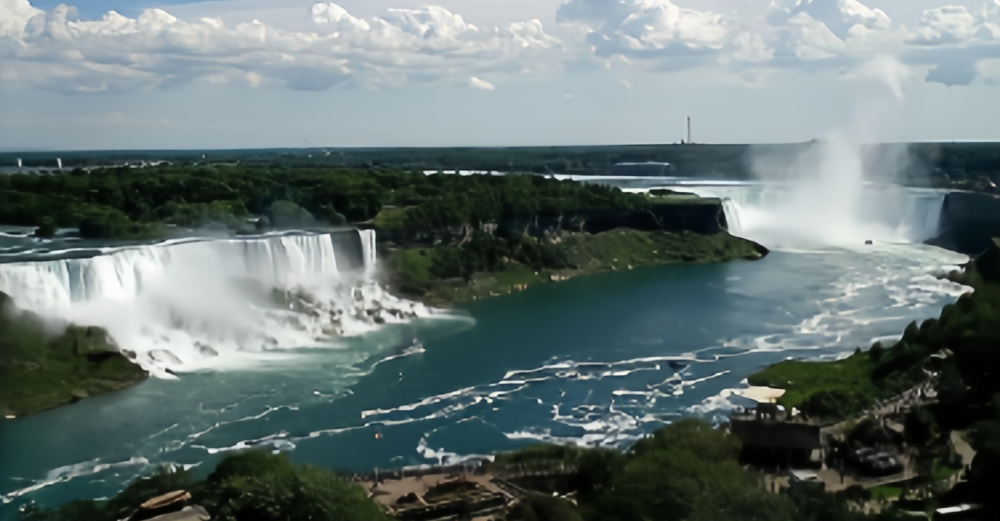
Niagara Falls are a dramatic feature of upstate New York’s border with Canada.
高阶
考察综合知识板块理解与分析
1. The guide's structure (Sections on Music/Art Fundamentals, Land Use, Natural World, etc.) suggests that understanding environmental art requires:
A) Focusing solely on the artist's biography.
B) Only looking at pretty pictures of nature.
C) A multidisciplinary approach combining knowledge of artistic techniques, history, music, and specific environmental issues.
D) Ignoring the historical context of art.
2. Compare Ferde Grofé's "On the Trail" and Amy Beach's Hermit Thrush at Morn. Both are programmatic/character pieces, but a key difference is:
A) Grofé's piece has no melody, while Beach's is all melody.
B) Only one of them is by an American composer.
C) Grofé uses a large orchestra to depict a narrative scene, while Beach uses a solo piano to create a mood inspired by a transcribed birdsong.
D) Beach's piece tells a clear story, while Grofé's does not.
3. The appropriation techniques used by Kent Monkman and the collaborative protest actions of Allora & Calzadilla both serve to:
A) Critically engage with history, politics, and power structures related to land and representation.
B) Promote traditional artistic skills like oil painting.
C) Create decorative objects for museums.
D) Faithfully copy and preserve past artworks.
4. Analyzing Takemitsu's Rain Tree and Li Gang's Bottom Color series together reveals a shared concern with:
A) The direct, physical, and philosophical connection between artistic materials and the natural world.
B) Using the most technologically advanced materials.
C) Telling explicit political stories.
D) Creating large-scale public monuments.
5. Will Wilson's photographic work and the historical context provided for landscape painting both address the myth of the American West as "empty" land. Wilson's work counters this by showing:
A) Only wildlife, not people.
B) Beautiful, uninhabited deserts.
C) That the land has always been empty.
D) The ongoing presence of Indigenous people and the lasting environmental damage from industrial exploitation.
6. The guide explains that Beethoven's "Pastoral" Symphony uses identifiable bird calls. This is an example of how programmatic music in the Romantic era sought to:
A) Avoid any reference to the real world.
B) Be more abstract than Baroque music.
C) Use only human voices.
D) Imitate nature directly to enhance its expressive and descriptive power.
7. Consider the evolution of "landscape" from a background (Renaissance) to a main subject (Dutch painting) to a politically charged concept (Manifest Destiny) to a medium for activism (eco-art). This progression best illustrates that:
A) The meaning and purpose of artistic genres are fixed and unchanging.
B) How artists represent land is deeply connected to the cultural, political, and environmental concerns of their time.
C) Landscape painting has gotten progressively less skilled.
D) Only modern artists care about the environment.
8. Both Rimsky-Korsakov's "Flight of the Bumblebee" and Beach's Hermit Thrush at Morn involve the musical portrayal of non-human creatures. However, their approaches differ fundamentally because:
A) Rimsky-Korsakov depicts the creature as part of a magical narrative, while Beach attempts to faithfully incorporate its actual song into an artistic composition.
B) Only one of the creatures is real.
C) Rimsky-Korsakov's piece is serious, while Beach's is humorous.
D) Beach's piece is for orchestra, while Rimsky-Korsakov's is for piano.
9. The resource guide itself can be seen as an argument for the importance of arts education in understanding environmental issues because it:
A) Suggests that only artists can solve climate change.
B) Claims science alone has all the answers.
C) Is meant to replace science textbooks.
D) Demonstrates how art and music provide unique ways of seeing, hearing, questioning, and emotionally connecting to ecological themes.
10. If an art historian were to analyze Allora & Calzadilla's Land Mark (Foot Prints), they would likely emphasize not just the photographs, but also the process (trespassing, protest, imprinting). This shift in focus is characteristic of much:
A) Renaissance art analysis.
B) Portrait painting.
C) Contemporary art, where the concept, action, or performance is often as important as the final object.
D) Analysis focused solely on formal qualities like color and line.
11. The use of spotlighting in Takemitsu's Rain Tree performance transforms it from a purely auditory experience to a theatrical one. This aligns with a broader 20th/21st-century trend in music to:
A) Always perform in total darkness.
B) Hide the performers from view.
C) Prioritize recording over live performance.
D) Integrate visual elements into the performance.
12. Comparing the depictions of storms in Baroque opera (e.g., Vivaldi, Marais) and in Beethoven's symphony, one could argue that Beethoven's version is more dramatically integrated because:
A) It is part of a multi-movement symphonic narrative about nature, with the storm serving as a central dramatic climax.
B) It is shorter.
C) It uses older instruments.
D) It has words to explain it.
13. The guide notes that Li Gang's work exists in a "fluid borderland between painting, sculpture, and installation." This reflects a broader contemporary tendency to:
A) Value painting above all other forms.
B) Strictly adhere to traditional category definitions.
C) Make art that is only one specific type.
D) Blend or transcend traditional artistic media and categories.
14. The "Four Pictures of the Grand Canyon" was the original working title for Grofé's suite. Changing it to Grand Canyon Suite likely served to:
A) Make it sound less descriptive.
B) Focus only on one picture.
C) Shorten the title.
D) Align it with a recognized musical genre (the orchestral suite), framing it as a serious concert work.
15. The fact that Will Wilson also creates portrait series using historical techniques (wet plate collodion) alongside his "Survey" landscape photos suggests his overall practice aims to:
A) Separate issues of environmental justice from those of cultural representation.
B) Address both the misrepresentation of Indigenous people and the environmental exploitation of their lands as interconnected issues.
C) Copy the style of Edward S. Curtis.
D) Work in only one style.
16. The concept of site-specificity (discussed regarding Richard Serra and Land Art) is relevant to eco-art because it emphasizes:
A) The inseparability of the artwork from the location for which it is created, often engaging directly with that place's physical and cultural characteristics.
B) Making art only in galleries.
C) Creating art that can be displayed anywhere.
D) Ignoring the site where the art is placed.
17. When the guide states that in Hermit Thrush at Morn, "the final pitch that the thrush sings is a 'C'—it does not resolve... the thrush needed more musical training!" this is a humorous way of highlighting:
A) The inherent tension between raw, natural sound and the structured rules of Western harmony.
B) The bird's lack of intelligence.
C) That the piece is in the wrong key.
D) Beach's poor transcription skills.
18. Analyzing the political dimension of Monkman's The Fourth World requires understanding both art history (Bierstadt, Serra) and North American history (Manifest Destiny, cultural appropriation). This demonstrates that art interpretation often requires:
A) Only a knowledge of color theory.
B) Accepting the artwork at face value.
C) No external knowledge.
D) Interdisciplinary knowledge to unpack layers of meaning.
19. The guide's introduction connects prehistoric cave paintings, Roman murals, and Chinese landscapes to modern eco-art. This long timeline is used to argue that:
A) All art is essentially environmental art.
B) Only modern art is valuable.
C) Human interpretation of the natural environment through art has a very long history, but the purposes and contexts have evolved dramatically.
D) Art has never changed.
20. If a composer today wanted to create a piece about climate change-inspired migration, they might draw on techniques discussed in the guide such as: programmatic storytelling (like Grofé), evocative use of timbre and texture (like Takemitsu), and:
A) Incorporating non-musical sounds or data (extending the definition of "sound organized in time").
B) Only using major scales.
C) Avoiding any emotional content.
D) Copying Beethoven's Fifth Symphony exactly.

立即行动:测一测你的艺术感知力水平
识别‘Landscape painting’”——这只是起点。你能否洞察Kent Monkman在The Fourth World中对Bierstadt风景画的挪用与批判?能否理解Allora & Calzadilla在Land Mark (Foot Prints)中如何用短暂足迹对抗永久占领?能否体会Li Gang在Bottom Color series中用家乡土壤重构的情感与生态记忆?
这份《艺术学科模拟真题》引导你超越审美表象,通过艺术的形式与观念,构建批判性思考环境议题的视觉分析能力。
课程席位有限
请即刻扫码预约咨询
携手开启通往顶尖学术舞台的征程!
课程及赛事咨询
请添加小助手微信

SD寒假辩论/演讲系统课程内容介绍:
L1-Foundation|辩论基础班:从零基础到自信开口爱上英语辩论
L4 Advanced|美辩高级班:深度来袭,在复杂辩题中破局与制胜
L5 Advanced+|辩论晋阶班:思辨重构,在多元价值世界中寻找思想的支点
BP提高班|从“角色扮演”到“策略大师”:锻造核心思辨力与全方位领导力
BP高级班|突破瓶颈,主导议场:高阶框架构建与决胜策略
SD正在报名的赛事及培训:
正在报名|第40届斯坦福大学邀请赛「Stanford Invitational l 2026」
正在报名|第24届哥伦比亚大学邀请赛「Columbia Invitational l 2026」
正在报名|TOC 演讲与辩论锦标赛-2「4th Annual TOC」
正在报名|哈佛国际辩论锦标赛 ISDI #3
哈佛、斯坦福、宾大备赛课程(PF赛事使用相同的辩题):
斯坦福大学邀请赛:2月7-9日
哈佛大学锦标赛:2月13-16日
宾夕法尼亚大学精英赛:2月8-9日
我们凭借在海外赛事组织与辅导方面的丰富经验,提供与国际赛事高度契合的备赛课程,全程协助参赛选手进行赛前集训和指导。备赛班同时有专业的资料包,提供完备的带赛指导及全程赛事服务。
SDcamps·演辩营组织美国重量级的海外赛、国际赛已有7年时间,高度专业化的教练团队积累了丰富的美国赛事组织和按美国辩论教育体系建立的原汁原味的美辩的辩论培训课程。
哈佛、斯坦福、耶鲁、普林斯顿等名校赛事部分赛报:
赛报:刷新第39届斯坦福新纪录:WSDC-Varsity季军,Parli-TOC十六强,辩手第2
赛报:第21届哥伦比亚邀请赛JV PF组八强+优辩|Columbia Invitational
赛报:乔治城大学秋季赛冠军|Georgetown University
加入SD海外赛战队!
如果你想挑战海外赛,如果你想和海外辩手对垒,和美/加等国的同龄人交锋互动,快来加入SD海外战队吧!SD有丰富的海外赛事组织经验,强大的教练团队,系统的培训能力,从辩论小白直到冠军辩手都能找到你的位置!
没有经验?不用担心!
没有队友?没有关系!
快来联系我们吧!
SD带你一起飞!
26美国名校/亚太海外赛事时间表
上述赛事所安排的时间,除报名系统中特别注明外所标时间均为主办方所在地区的当地时间。
高含金量的美国名校及亚洲国际性赛事,等你来战!
其他赛事与课程报名

WSC世界学者杯新赛季备赛课程(学术&辩论班 ):
WSC世界学者杯2026新赛季中国区域轮各城市已经开始报名,2026年3月份之前仍然使用2025WSC主题:重燃未来 Reigniting the Future
WSC一共涵盖六个学科、四个竞赛环节,辩论是竞赛环节含金量最高的项目。我们有丰富的WSC辅导经验,胜迹卓著,提前备赛,先人一步!
WSC世界学者杯2026新赛季中国区域轮近期各城市举办时间及举办学校列表:
一文教会你如何准备WSC世界学者杯辩论
WSC夺冠秘籍|2025世界学者杯
WSC辩论五步大通关|2025世界学者杯
赛事与课程报名


赛事报名
首次报名的选手请扫描下方的二维码进行注册,注册后填写辩手(或辩论队)信息完成报名。已经参加过赛事的选手可直接进行报名。

课程及备赛报名
首次报名的选手请扫描下方的二维码进行注册,注册后填写辩手信息完成报名。已经参加过赛事的选手可直接进行报名。

课程及赛事咨询
请添加小助手微信